The hard part is not deciding whether to report an AMC result. It is writing it so that a reader who does not know the AMC can tell what it means. An admissions officer reading a file from an international school in China may see “AMC 10 — Honor Roll” and have no reliable way to place it. Your job, in a tightly capped field — confirm the current limit for each section on commonapp.org — is to supply the organiser and the selectivity without inflating either.
This article covers where AMC results go on the Common App, how to phrase them, and what each tier honestly signals. It does not cover the competition mechanics — for how the sitting works, see our guide to the 2026 in-person AMC rules and authorised test centres. Confirm award names and qualification policy on maa.org, and confirm application field limits on commonapp.org, since both change.
Start with what is actually verifiable
Before drafting anything, separate three categories, because they carry very different weight and very different risk.
- Things MAA issues. A named award tier, or an invitation to the next round. These have a defined meaning, are recorded, and can be described plainly.
- Things that are true but soft. Your raw score, your position within your own school or centre, the number of times you have sat the competition. True, but not independently meaningful to an outside reader, and easy to phrase in a way that overstates.
- Things you should not claim. Any rank, percentile or comparison you cannot support — national placements you were never given, or a percentile you calculated yourself from a cutoff you read online.
The honesty bar here is practical, not moral posturing. Admissions offices read thousands of files from the same handful of international schools in a given city, and an entry that overstates a common competition is more likely to be recognised as overstatement than to pass unnoticed. A precise, modest entry outperforms an inflated one. Some institutions also ask applicants not to report items they cannot verify, or ask for documentation later — check each institution’s own instructions rather than assuming a universal rule.
Honors section or activities section?
On the Common App these are different fields doing different jobs, and AMC work can legitimately appear in both. The honors section takes up to five academic honors, each recorded with its title, when you received it, and the level of recognition — school, regional, national or international. The activities section describes sustained commitments and includes a short description field limited to 150 characters. Confirm the current number of activity slots and all character limits on commonapp.org, as these are revised between cycles.
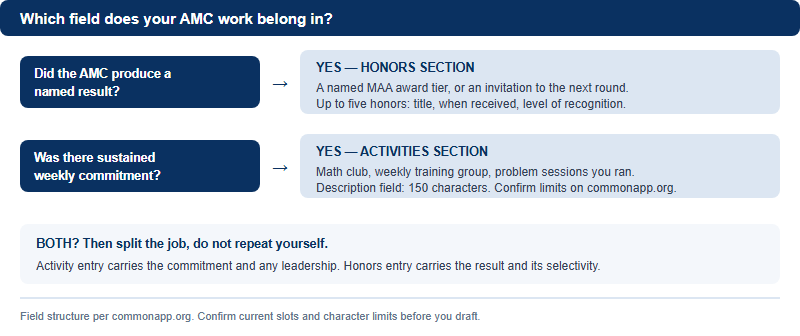
A student with one strong result and no club has one honors entry and nothing else. A student who trained weekly for two years and never earned a named award still has a genuine activity — sustained, self-directed academic work is worth describing, and it is not made dishonest by the absence of a trophy. What you should not do is convert the same fact into both an honor and an activity to make it look like two things.
Writing the entry: the character-limit problem
Short fields punish jargon. Every word spent on an abbreviation the reader cannot decode is a word not spent on the two things that actually transmit meaning: who runs it and how selective it is. Compare:
| Weaker phrasing | Why it underperforms | Stronger phrasing |
|---|---|---|
| AMC 10 participant | Names nothing verifiable and no organiser; reads as attendance | American Mathematics Competitions (AMC 10), Mathematical Association of America — sat Nov 2026 |
| AMC Honor Roll winner | “Winner” overstates a tier award; reader cannot place the tier | AMC 10 Honor Roll, Mathematical Association of America (US national competition) |
| Qualified for AIME (top student) | “Top student” is an unsupported self-assessment | Invited to the AIME, the MAA invitational round — qualification at 100 or above on the AMC 10 |
| Math competition, 2 years | No organiser, no cadence, no role | Weekly AMC training group, co-led sessions of 12 students, Grades 10–11 |
| Top 1% nationally in AMC | A percentile you worked out yourself rather than the award as issued; if you earned the Distinguished Honor Roll, name that award instead | Use the published invitation threshold instead, or state the award as issued |
Two rules do most of the work. First, name the organiser once — the Mathematical Association of America — because that single phrase converts an unknown abbreviation into a recognisable US institution. Second, quote a published threshold rather than a self-calculated rank. Saying that AIME qualification sits at 100 or above on the AMC 10 — the threshold MAA has set for 2027 — is a statement of policy you can point to; saying you were “top 1% nationally” is a claim you invented, and it will not survive a follow-up question. If you are describing a sitting from an earlier cycle, quote the rule that applied then rather than the current one.
Translating each tier for a reader who does not know the AMC
The tiers below run from least to most selective. The translations in the right-hand column are our own editorial suggestions for how to convey each honestly — they are not MAA language and not an admissions office’s view.
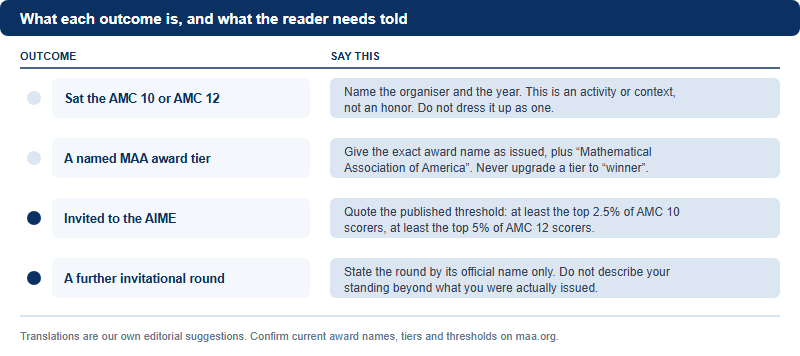
Note what the ladder deliberately does not contain: score numbers. A raw score means nothing without that year’s paper and that year’s field, and MAA is explicit that thresholds depend on the difficulty of each individual competition. If you have a named award, the award already encodes the outcome. If you do not, a score will not rescue the entry.
The ambiguity nobody warns China-based applicants about
This one is specific to applicants from schools in China and the wider Asia-Pacific region, and it is the most avoidable error on this page. At least three different competitions are commonly abbreviated “AMC” or “AMO”, and students at the same school often sit different ones.
- The American Mathematics Competitions (AMC 8, AMC 10, AMC 12) — run by the Mathematical Association of America in the United States, running since 1950, leading to the AIME. This is the one this site covers.
- The Australian Mathematics Competition — a different competition, run by the Australian Maths Trust, with its own structure, year levels and awards.
- The American Mathematics Olympiad (AMO) — despite the name, organised by SIMCC in Singapore, with its own divisions and awards.
All three are legitimate competitions. The problem is purely one of naming: an entry reading “AMC — Distinction” on an application from an international school in Shanghai is genuinely ambiguous, and a reader who resolves it to the wrong competition has misread your file — possibly in your favour, which is worse, because it is the kind of thing that unravels badly if it ever comes up. Write the full competition name and the organiser, every time. It costs perhaps forty characters and removes the ambiguity completely.
Four things not to do
- Do not list every sitting separately. Five honors slots are scarce. Three entries for AMC 10 across three years crowd out genuinely different achievements and signal padding rather than depth.
- Do not upgrade the language. A tier award is not a “prize” and not a “championship”. Invitation to a further round is not “selection for the national team”. Use the noun that was issued to you.
- Do not translate into a domestic-competition equivalent. Mapping an AMC result onto a Chinese olympiad tier for a US reader introduces a comparison neither organisation endorses.
- Do not build the whole application on it. A competition result is one academic signal, read alongside your transcript, course rigour, recommendations and everything else. No AMC outcome guarantees admission anywhere, and any programme telling you otherwise — ours included — is selling rather than advising.
If you are applying outside the US as well, note that other systems handle this differently: a UK application, for instance, carries this kind of evidence in the personal statement rather than a structured honors list, so the same result needs rewriting rather than copying. Confirm current formats on the relevant application body’s own site.
A sensible sequence for this season
Nothing above can be drafted usefully before there is a result to describe, so the order matters. Secure the seat first — AMC registration runs through schools, universities, math circles and learning centres rather than individual sign-up, and the sitting has its own in-person requirements, which our guide to the 2026 in-person rules sets out. Sit the competition. When the result arrives, record the exact award name and wording as issued, rather than paraphrasing it months later from memory. Then draft the entry against the tiers above, keep it under the character limit, and have someone who does not know the AMC read it and tell you what they think it means. If their answer matches reality, the entry works.
Frequently asked questions
Where do AMC results go on the Common App?
A named award or AIME invitation belongs in the honors section, capped at five entries; ongoing training or a math club belongs in activities.
How selective is an AIME invitation?
For 2027 MAA has set fixed thresholds of 100 on the AMC 10 and 85 on the AMC 12, replacing the earlier percentile bands. Confirm current policy on maa.org.
Should I write “AMC” or the full competition name?
Write the full name and the organiser, MAA. Three different competitions are called AMC or AMO, so the abbreviation alone is ambiguous.
Does a strong AMC result guarantee admission?
No. It is one academic signal among many, read alongside your transcript, courses and the rest of the application. No result guarantees an outcome.
This is an independent English-language guide operated by Hanlin Education for China-based international-school students. It is not affiliated with, endorsed by, or sponsored by the Mathematical Association of America (MAA), nor by Common App, Inc. Phrasing suggestions above are our own editorial judgement, not admissions-office guidance, and no competition result guarantees admission to any institution. Award names, tiers, thresholds and application field limits change between cycles — confirm current details on maa.org and commonapp.org, and follow each institution’s own reporting instructions. If you spot an error, tell us and we will correct it within 7 working days.