The AIME is not a harder AMC. It is a structurally different exam, and the difference is the answer choices. The AIME asks for 15 answers, each an integer from 0 to 999. From 2027 it runs as two 90-minute parts — eight questions, then seven — taken electronically at a Pearson Professional Center, with part one closed once part two begins. Take away the five options and roughly a third of standard AMC technique stops working overnight; take away the ability to go back, and how you allocate the first 90 minutes matters more than it used to. Students who qualify and then train the same way they always did tend to be surprised by this in February rather than in October.
This article is about the training shift, not the qualification mechanics. If you are still working toward a seat and a score, start with the sitting itself — our guide to the 2026 in-person AMC rules and authorised test centres covers how the AMC is administered. Confirm all current AIME dates, rules and permitted materials on maa.org.
Who sits it, and what the invitation actually means
The AIME is invitational, and the basis for the invitation has just been rewritten — which reverses the advice this article originally gave. MAA has replaced the percentile bands with set numbers: 100 or above on the AMC 10, 85 or above on the AMC 12. The cutoff is now a fixed number you can train toward, where before it was set after the fact against that year’s paper. If you are working toward the AIME on the AMC 10, the honest planning question is now which six or seven questions get you to 100, rather than how hard the paper turns out to be. MAA says full AIME policies are still to be posted, and candidates in the AMC international programme should follow the policies of the International Group Leader for their country or region.
Two consequences follow, and they point in opposite directions. First, you cannot plan around a target cutoff, so the sane objective is simply to be well clear of the region where a two-point swing decides your season. Second, because the AIME window comes after the AMC, the natural instinct — start AIME preparation only once the invitation arrives — leaves a short runway. The better pattern is a small, steady AIME strand running alongside AMC work for students plausibly in range, and a full switch afterwards.
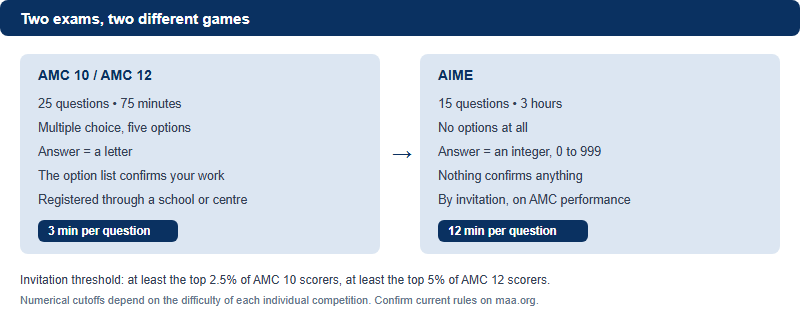
The structural comparison, in full
| AMC 10 / AMC 12 | AIME | What it does to your training | |
|---|---|---|---|
| Questions | 25 | 15 | Each AIME question carries far more weight; one careless slip is expensive |
| Time | 75 minutes | 3 hours | Endurance and re-checking become real skills, not afterthoughts |
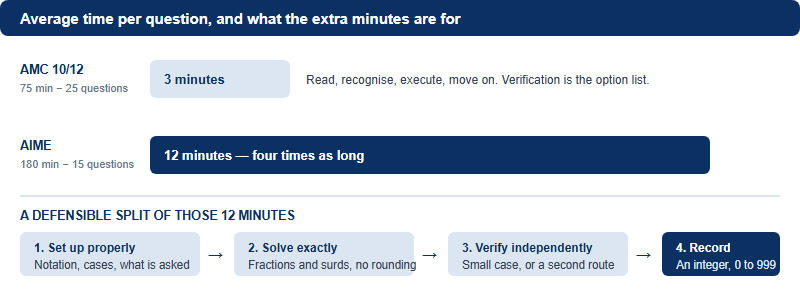
| Average time per question | about 3 minutes | about 12 minutes | Long multi-step solutions are now expected, not a sign you went wrong |
| Answer format | Choose from five options | An integer from 0 to 999 | Backsolving, elimination and estimation all stop working |
| Feedback while working | Your answer appears in the list, or it does not | None — nothing confirms you are right | You must build your own verification habits |
| Entry | Register through a school or centre | By invitation, on AMC performance | The AMC sitting is the gate; treat it as such |
Read the fourth row again, because it is the whole article. On the AMC, the answer list is a piece of information the examiner hands you for free. It tells you the answer is one of five things, it tells you the rough size and form of the answer, and it silently confirms your work the moment your value appears among the options. The AIME removes all of that.
Four AMC habits that quietly stop working
These are not bad habits. They are correct, high-value AMC technique. They simply have no purchase on an exam with no options, and the students who suffer most are usually the ones who trained them hardest.
- Backsolving. Substituting each option into the condition until one fits is often the fastest AMC route, especially on word problems and equations that resist a clean rearrangement. On the AIME there is nothing to substitute. Every problem must be solved forwards.
- Elimination by form. On the AMC you can frequently discard options because they are negative, non-integer, too large or the wrong parity, and then choose between the two survivors. The AIME answer is already known to be an integer from 0 to 999, so that information is worth nothing — it applies to every problem equally.
- Estimation to the nearest option. If the options are far apart, an approximate calculation picks the winner. The AIME wants the exact integer. Approximation can still guide you, but it can never finish a problem.
- The silent confirmation. This is the one students do not notice they rely on. When your value appears in the list, you stop worrying and move on. Remove the list and that reassurance disappears, which is why a common first experience of the AIME is finishing a problem, being unable to tell whether it is right, and losing several minutes to unfocused anxiety.
What replaces them: exactness, and your own verification
The AIME rewards a different cluster of skills. Four are worth building deliberately.
Carrying exact values. Because the answer must be an exact integer, you cannot round mid-solution and hope. Fractions and surds have to survive the whole calculation and cancel at the end. Many AIME answers arrive as a fraction whose numerator and denominator you are asked to combine in some specified way, so comfort with exact arithmetic is not optional. Practise finishing problems without ever reaching for a decimal.
Self-verification. Since nothing external confirms your answer, you need internal checks that are genuinely independent of the method you used. Re-reading your own algebra is a weak check — it tends to reproduce the original error. Strong checks include testing a small case by hand, checking a boundary or degenerate configuration, computing the same quantity a second way, and sanity-checking the size of the answer against the setup. Building these into your practice is the single highest-return AIME habit.
Sustained concentration. Three hours is long. Students who have only ever trained in 75-minute blocks routinely report that their accuracy falls off in the final hour, which is exactly when the harder problems are still open. This is trainable, but only by actually training it — occasional full-length sessions, not just problem sets.
Knowing when to leave a problem. Twelve minutes of average time does not mean twelve minutes each. It means some problems take four and some take twenty-five, and the judgement call is when a line of attack has stopped producing progress. On the AMC you abandon a problem in ninety seconds; on the AIME, abandoning too early is as costly as abandoning too late.
How the practice itself has to change
Four concrete adjustments, in rough order of how much they matter.
- Cover the answers on AMC practice, starting now. The cheapest possible AIME preparation is to do your ordinary AMC practice without looking at the options until you have committed to a value. It costs nothing, it can start months before any invitation, and it exposes exactly how much of your accuracy was being propped up by the list. Many students find the honest number uncomfortable, which is the point.
- Stop grading yourself only on right or wrong. On an exam where you cannot check, “I was right and I knew I was right” and “I was right but I was guessing” are completely different outcomes. Mark your confidence before you check the answer. The gap between confidence and correctness is the thing AIME training has to close.
- Write full solutions, not answers. AMC practice tolerates scratch work because only the letter is scored. AIME problems have enough steps that untidy work becomes its own error source, and a legible solution is also what makes independent verification possible. This is one of the few genuine carry-overs into olympiad-style writing later.
- Do full-length sessions occasionally. Not weekly — three hours is a large commitment and doing it too often degrades quality. But a student who has never sat three continuous hours before the real thing is testing their concentration for the first time on the day that counts.
The trap: preparing for the AIME instead of getting there
The most common planning error we see is a student who becomes interested in AIME material in September and quietly reduces the AMC work that determines whether they will sit the AIME at all. It is an understandable trade — harder problems are more interesting than drilling accuracy — but it is the wrong one, because the invitation is decided entirely by AMC performance, and the AMC rewards speed and accuracy on a broad, moderate-difficulty range rather than depth on hard problems.
A defensible allocation for a student in plausible range: keep the substantial majority of preparation on AMC-format work through the autumn sitting, with a small AIME strand for exposure — primarily the covered-answers habit and occasional longer problems. Then switch decisively once results are known. Both AMC sittings are in-person events at authorised centres with their own logistics, and those need to be settled well before any of this study planning matters; our walkthrough of the in-person requirements sets out what to check with your centre. Confirm all dates on maa.org.
One last note on expectations. Qualifying for the AIME already places a student in a small minority of AMC participants, and a modest AIME score is a real result, not a disappointment. Nothing here should be read as a promise about outcomes at any stage — a fixed threshold tells you what to aim at, not whether you will hit it, and no preparation programme, ours included, can guarantee a qualification or a score.
Frequently asked questions
What format are AIME answers?
Each AIME answer is an integer from 0 to 999. There are no answer choices, so exact values matter. Confirm current entry instructions on maa.org.
How do students qualify for the AIME?
On AMC performance, but from 2027 against fixed scores rather than percentiles: 100 or above on the AMC 10, 85 or above on the AMC 12.
Is there a fixed AIME cutoff score I can aim for?
No. MAA states the numerical cutoffs depend on each competition’s difficulty, so they move year to year. Confirm on maa.org.
How long is the AIME compared with the AMC?
The AIME is 15 questions in 3 hours, about 12 minutes per question, against roughly 3 minutes per question on the AMC.
This is an independent English-language guide operated by Hanlin Education for China-based international-school students. It is not affiliated with, endorsed by, or sponsored by the Mathematical Association of America (MAA). Training recommendations and time splits above are our own editorial judgement, not official MAA guidance, and no preparation can guarantee qualification or any particular score. Dates, invitation policy, permitted materials and rules change from year to year — always confirm current details on maa.org. If you spot an error, tell us and we will correct it within 7 working days.