The AMC 10 and AMC 12 share a length, a question count and a scoring system. What they do not share is a syllabus. The AMC 12 is written against the full high-school curriculum, which the MAA describes as adding trigonometry, advanced algebra and advanced geometry — the ground where logarithms and complex numbers sit; the AMC 10 stops short of it. Calculus appears on neither. That delta — three topic blocks, not a general step up in difficulty — is most of what separates preparation for the two papers.
This article maps the extra content, shows how each block actually shows up on a paper rather than how it is taught in school, and proposes a learning order. Confirm the current syllabus wording, dates and eligibility on maa.org before you plan against anything here.
The delta, precisely
Start with what is identical, because students routinely overestimate the difference. Both papers are 25 multiple-choice questions in 75 minutes, scored 6 points for a correct answer, 0 for an incorrect one and 1.5 for a blank, giving a maximum of 150. No calculator or similar electronic device is permitted on either. In 2026 both are sat in person at authorised centres, with the A papers on 5 November and the B papers on 13 November — our summary of the 2026 in-person arrangements covers the logistics that changed this cycle.
Eligibility differs, and it has two conditions rather than one. The AMC 10 is for students in grade 10 or below who are also under 17.5 years old on the day of the contest; the AMC 12 is for students in grade 12 or below who are also under 19.5 years old on the day of the contest. Both the grade condition and the age condition must hold — verify the current rule on maa.org rather than relying on a summary.
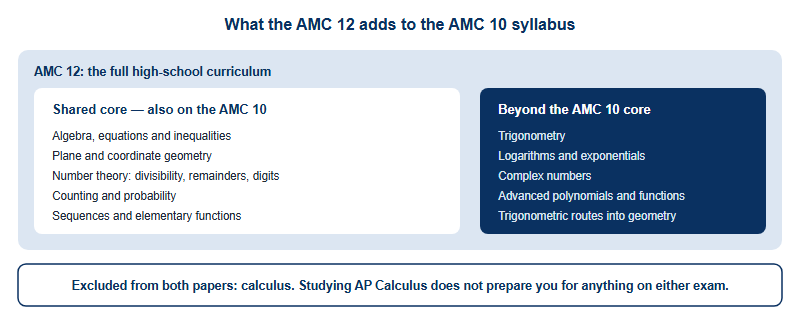
That last line in the diagram is worth dwelling on, because it surprises families every year. A grade 11 student taking AP Calculus BC often assumes they are therefore “ahead” for the AMC 12. They are not. Calculus is outside the syllabus. The topics that matter are ones many international schools cover thinly or late — and being strong at derivatives buys you nothing on a paper that never asks for one.
Trigonometry: usually a geometry tool, not a topic
Trigonometry has the largest surface area of the three blocks, and school courses tend to prepare students for the wrong part of it. The AMC 12 rarely rewards long identity manipulation for its own sake. It rewards being able to choose between a synthetic route and a trigonometric one, and being fluent enough that the trigonometric route does not cost you five minutes.
The high-value pieces, roughly in order of how often they earn their keep:
- Unit-circle fluency and exact values. Sine, cosine and tangent at the standard angles, in all four quadrants, recalled instantly. With no calculator available, an exact-value hesitation is pure lost time.
- Law of Sines and Law of Cosines. The workhorses. Any triangle problem where you know a mixture of sides and angles and the synthetic route is not opening up.
- Area = ½ab sin C. The single most useful area formula on the paper, because it turns an awkward triangle into two sides and the angle between them.
- Double-angle and angle-sum identities. Enough to simplify, not enough to prove things. Sum-to-product appears occasionally; recognise it rather than memorising a wall of forms.
- Periodicity for counting solutions. “How many solutions does this equation have on a given interval” is really a counting question dressed in trigonometry, and it is a recurring style.
A practical note for students coming from a Chinese-curriculum background: your trigonometric manipulation is often stronger than your Western-curriculum peers', while your comfort with coordinate-geometry hybrids may be weaker. Test both before deciding where to spend time.
Logarithms: comparison and change of base, not equation drills
Logarithms have the smallest surface area of the three blocks, which makes them the cheapest to acquire — a genuinely good return on a few weeks. School courses drill solving log equations. The AMC 12 asks for something a little different.
| Block | What school usually drills | What the AMC 12 tends to want | Highest-value habit |
|---|---|---|---|
| Trigonometry | Proving identities; graphing transformations | Using trig as a lever inside a geometry problem; counting solutions on an interval | Ask "can I finish this synthetically?" before reaching for the Law of Cosines |
| Logarithms | Solving single log equations for x | Comparing sizes; change of base; nested and self-referential structures; logs inside sequences | Return to the definition — a log is an exponent — whenever the algebra stalls |
| Complex numbers | Arithmetic in a + bi form; conjugates | Roots of unity; De Moivre; multiplication read as rotation and scaling | Convert to modulus–argument form early; most structure is invisible in a + bi |
Three specific logarithm habits pay repeatedly. First, change of base is not an exotic manoeuvre; treat it as the default move whenever two logs with different bases appear in the same expression. Second, comparison without computation — deciding which of two logarithmic or exponential expressions is larger — is a recurring style, and it is approached by finding a common base or a common exponent, never by estimating decimals. Third, domain discipline: arguments must be positive, which means a log equation can generate roots that must then be discarded. Extraneous roots are a favourite source of distractors, and they cost you the full 6 points while a blank would have paid 1.5.
Complex numbers: narrow, but the highest leverage per hour
Complex numbers have the narrowest footprint of the three blocks and the steepest payoff, because the ideas involved are few and they unlock a whole class of otherwise painful problems.
The central shift is to stop thinking of a complex number as an algebraic object and start reading it geometrically. In modulus–argument form, multiplication is rotation combined with scaling. Once that is instinctive, several things become straightforward:
- Roots of unity. The n solutions of zn = 1 sit at equal spacing on the unit circle. Their sum is zero for n greater than 1 — a fact that collapses some intimidating-looking sums to a single line.
- De Moivre's theorem. Raising to a power multiplies the argument and exponentiates the modulus, which makes high powers routine rather than laborious.
- Rotation in plane geometry. Placing a configuration in the complex plane and multiplying by a well-chosen unit complex number rotates it exactly. Some geometry problems that resist synthetic attack fall apart under this treatment.
The reason to schedule this block last is dependency, not difficulty: modulus–argument form assumes you are already comfortable with the unit circle and with radian measure, which is to say it assumes the trigonometry block.
A learning order that matches how the exam uses them
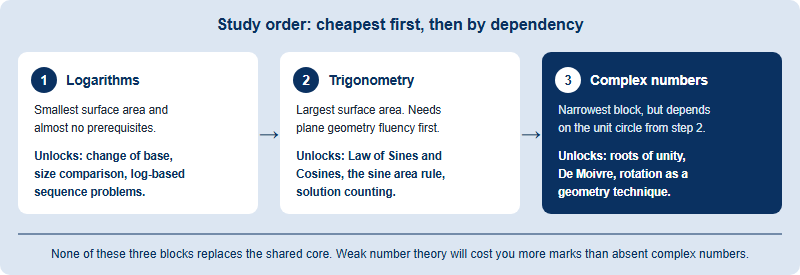
Two warnings about how to use this map. First, the extra blocks are an addition to the shared core, never a substitute for it. A student with elegant complex-number technique and shaky number theory will underperform a student with the reverse profile, because the core is where the majority of the paper lives. If your core is not solid, do not start this map at all.
Second, do not let the syllabus delta alone decide which paper you sit. Both routes lead onward to the AIME, and the qualifying thresholds are published by the MAA for each cycle rather than being fixed — so never plan against a number someone remembers from a previous year, and check the current position on maa.org. The blocks above tell you what preparation the AMC 12 requires; they do not by themselves tell you it is the right paper for you. If you are considering sitting both an A and a B paper this year, note that they fall on 5 and 13 November 2026 and are in-person sittings, which makes the venue and registration timing part of the decision too.
Frequently asked questions
Is calculus on the AMC 12?
No. The AMC 12 covers the high-school curriculum but excludes calculus, so AP Calculus study does not transfer. Confirm the wording on maa.org.
Can I take the AMC 12 without having studied trigonometry?
You can sit it, but you will meet questions you cannot start. Trigonometry has the widest footprint of the three extra blocks.
Which of the three blocks gives the fastest return?
Logarithms. The content is small and largely self-contained, so a few focused weeks usually converts into usable marks.
Are the AMC 10 and AMC 12 scored differently?
No. Both are 25 questions in 75 minutes, scored 6 for correct, 0 for wrong and 1.5 for blank, with no calculator permitted.
This is an independent English-language guide operated by Hanlin Education for China-based international-school students. We are not affiliated with, endorsed by, or sponsored by the Mathematical Association of America (MAA). Competition dates, eligibility rules, syllabus scope and scoring are set by the MAA and can change; always confirm current details on maa.org and with your authorised test centre. If you find an error in this article, tell us and we will correct it within 7 working days.