On the AMC 10 and AMC 12 you get 75 minutes for 25 multiple-choice questions — and no dictionary. The MAA’s permitted-materials rule lists only “writing utensils, blank scratch paper (NOT graph paper) provided by a teacher, rulers, compasses, and erasers.” Every word of the paper has to be understood cold, in English, at roughly three minutes per problem. For many China-based students that reading layer, not the mathematics, is the real ceiling.
Why do strong maths students lose points to English?
The pattern is familiar to anyone who coaches international-school students in China: a student solves a problem correctly in review, five minutes after the mock ends, with an expression of genuine confusion. The mathematics was never in doubt. What failed was a single word in the stem — distinct, at most, ordered, positive — that quietly redefined the answer set.
This is not carelessness, and treating it as carelessness is why it never gets fixed. It is a specific, trainable gap with three causes:
- Competition English is compressed. AMC stems are written to be unambiguous, not readable. Conditions are stacked into one sentence with no redundancy, so there is no second clue to recover from if you miss the first.
- Chinese mathematical training uses different default assumptions. Much of what a Chinese textbook signals through convention, an AMC stem states in a word you may skim past.
- Speed suppresses re-reading. At three minutes per problem, most students read the stem exactly once. Under time pressure, the brain fills gaps with what it expects the question to say.
The fix is not “read more carefully.” That instruction has never worked for anyone. The fix is to pre-load a specific vocabulary, build a re-reading habit that costs seconds rather than minutes, and keep a log of your own misreads until the pattern dies.
Which words actually change the answer?
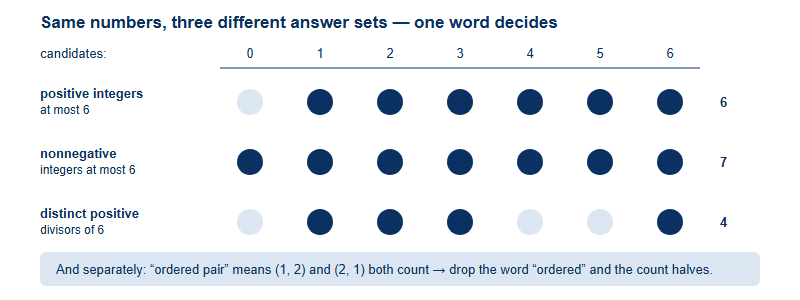
A small number of words carry almost all the risk, because each of them constrains the set of objects you are counting or the values you are allowed to use. Learn these as mathematical operators, not as vocabulary.
| Word or phrase | What it constrains | The classic misread |
|---|---|---|
| positive integer | Excludes 0 and all negatives | Including 0 because “natural number” habits differ; the AMC avoids the ambiguity by saying “positive” explicitly |
| nonnegative | Includes 0, excludes negatives | Read as a synonym for “positive” |
| distinct | No repeats allowed among the chosen objects | Counting repeats and inflating the total |
| at most / at least | Inclusive bounds (≤ and ≥) | Treated as strict inequalities, losing or gaining one boundary case |
| exactly | Equality, not a minimum | “Exactly two solutions” read as “at least two” |
| ordered pair / ordered triple | (1, 2) and (2, 1) are different objects | Counting each pair once and halving the answer |
| relatively prime (coprime) | Greatest common divisor equals 1 | Read as “both are prime” |
| consecutive | Successive terms with no gaps — check whether integers, evens or odds are meant | Assuming consecutive integers when the stem said consecutive even integers |
| inclusive | Both endpoints belong to the range | Off-by-one on the count |
| not necessarily drawn to scale | The picture is a schematic; lengths and angles in the figure prove nothing | Measuring the printed diagram and trusting it |
| in simplest radical form / as a common fraction | Fixes the answer’s presentation | Producing an equivalent but differently written value and failing to match a choice |
| the least / the greatest | An extremum is requested, not any valid value | Stopping at the first value that works |
Where do US and Chinese conventions genuinely differ?
Some gaps are not vocabulary at all — they are convention. A student can know every English word in the stem and still parse the mathematics through the wrong local habit.
| Area | What US competition writing does | What to watch for |
|---|---|---|
| “Natural numbers” | Generally avoided; stems say positive integers or nonnegative integers | Do not import a default about whether 0 is included — read the stated word |
| Trapezoid | US usage is itself split: many US school textbooks define it as exactly one pair of parallel sides, while competition and higher mathematics generally use at least one pair (so a parallelogram counts) | Do not rely on a default in either direction — AMC stems state the conditions they need explicitly. Separately, British-influenced schooling in China may teach “trapezium” for the same shape and “trapezoid” for something else |
| Median | Two unrelated meanings: the middle value of a data set, and the segment from a vertex to the midpoint of the opposite side | Decide from context in the first read, not the third |
| Billion | 109 | Long-scale habits and the Chinese 亿 grouping produce order-of-magnitude slips |
| Number grouping | Comma as thousands separator, point as decimal | Never read a comma as a decimal marker |
| Segment, ray and line | Written with overbars and arrows; AB without qualification often denotes a length | Confusing the length AB with the segment or the line through A and B |
| Average | Means the arithmetic mean unless another mean is named | Assuming a weighted or geometric mean |
| Regular polygon | All sides equal and all angles equal | Assuming equal sides alone is enough |
| Isosceles right triangle | Both conditions at once, so the angles are fixed at 45–45–90 | Reading only the second adjective |
| Unit square / unit circle | Side length 1 / radius 1 | Assuming an area of 1 for the circle |
One structural point belongs here too. The US AMC administered by the MAA is a different competition from the Australian AMC run by the Australian Maths Trust, and from AMO run by SIMCC in Singapore. Their papers, rules and any language arrangements are their own — do not assume what is true of one applies to another. If you are preparing for the MAA competitions, prepare for an English paper and confirm all arrangements with your authorized competition manager; the practical side is covered in our guide to the 2026 in-person AMC rules.
A three-pass reading protocol that costs 20 seconds
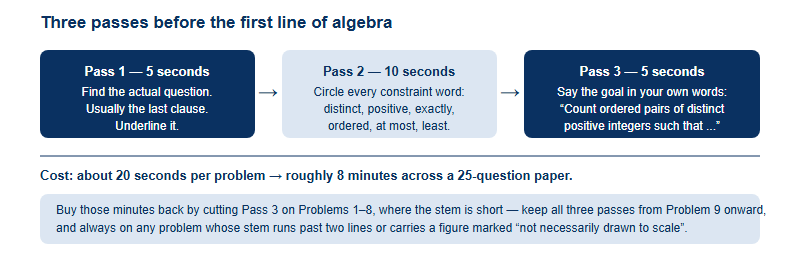
Re-reading an entire stem is expensive. Re-reading only the constraint words is not. The protocol below is what we drill with students in timed sessions; the total overhead is roughly 15–20 seconds per problem, which is comfortably repaid the first time it saves an answer.
A six-week drill that takes 15 minutes a day
Reading accuracy responds quickly to training because the vocabulary is small and closed. Six weeks of short daily work is usually enough to make the misreads disappear before a November sitting.
- Weeks 1–2 — stem mining. Take five old problems a day from the past-paper pack we have gathered — the AMC 10 set and AMC 12 set are split by level, and you can message us for the current version. Do not solve them. Only translate each stem into one Chinese sentence and one English sentence of your own, then check that both describe the same set of objects. Ten minutes.
- Weeks 3–4 — the misread log. Solve normally, but every time you get a problem wrong, classify it: maths error, arithmetic slip, or misread. Write the exact word you missed. Most students find two or three words account for the majority of their misreads.
- Week 5 — blind-stem drill. Cover the answer choices. Solve to a value, then reveal. This kills the habit of letting near-miss choices tell you what the question meant.
- Week 6 — timed integration. Full 75-minute papers with the three-pass protocol running. Score misreads separately from maths errors so you can see the curve.
Two rules make the log work. Log the word, not the problem, so patterns become visible. And review the log for two minutes before every timed paper — not the night before the exam, but every single session, until the words feel loud when you read them.
What this means on exam day. The 2026 papers are sat in person at authorized centers — AMC 10A and 12A on 5 November, AMC 10B and 12B on 13 November. Because the MAA’s permitted-materials list is exhaustive and contains no dictionary and no electronic device of any kind, every unfamiliar word has to be resolved from context under the clock. That is a strong argument for doing the vocabulary work in September rather than October, and for confirming your centre’s arrangements early using the 2026 in-person rules guide.
Three habits to carry in: underline the question clause on every problem; treat any figure as a schematic unless the stem says otherwise; and when an answer of yours matches a choice exactly but only after you assumed something the stem did not say, stop and re-read. Near-miss answer choices exist precisely to catch that assumption.
Frequently asked questions
Q: Can I bring a dictionary to the AMC?
No. The MAA lists permitted materials as writing utensils, blank scratch paper (not graph paper), rulers, compasses and erasers — confirm current rules on maa.org.
Q: Is the US AMC paper available in Chinese?
Prepare for an English paper. Any language arrangement is set by the MAA and your authorized competition manager, so confirm directly with them rather than assuming.
Q: How do I tell a misread from a careless mistake?
Re-read the stem before looking at the solution. If the correct method becomes obvious immediately, it was a misread and belongs in your word log.
Q: Does the three-pass method cost too much time?
It costs roughly 20 seconds per problem, about eight minutes over 25 questions. Trim Pass 3 on short early stems to buy that back.
This is an independent English-language guide operated by Hanlin Education for China-based international-school students. It is not affiliated with, endorsed by, or sponsored by the Mathematical Association of America (MAA). Competition dates, eligibility, permitted materials and all administrative rules are set by the MAA and can change — always confirm current details on maa.org and with your authorized competition manager. Note that the US AMC (MAA) is a different competition from the Australian AMC (AMT) and from AMO (SIMCC, Singapore). If you spot an error, tell us and we will correct it within 7 working days.