The USAMO and USAJMO are the proof-based national olympiads that sit one rung above the AIME in the MAA's competition ladder. You reach them by clearing the AMC, qualifying for and sitting the AIME, and then scoring well enough on the AIME itself. For 2027, MAA states that USAMO and USAJMO qualification “will be primarily based on AIME scores; AMC scores will no longer be a factor in qualification.” The complete criteria have not been posted yet. The USAMO sits on the AMC 12 track and the USAJMO on the AMC 10 (junior) track. Both ask for full written proofs, not multiple-choice answers. Confirm all current rules on maa.org.
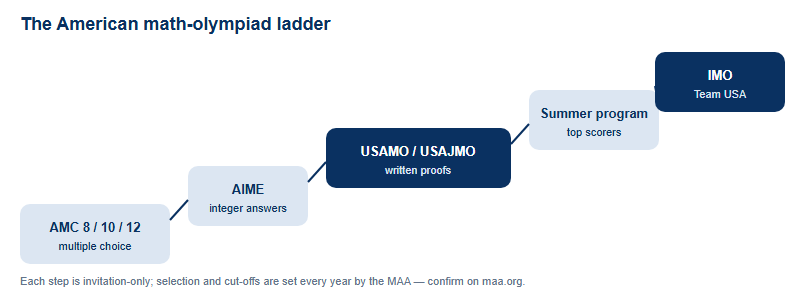
Where the USAMO and USAJMO sit on the ladder
Most students meet the American Mathematics Competitions at the bottom of a long ladder: AMC 8, then AMC 10 or AMC 12. Score high enough on the AMC 10/12 and you are invited to the AIME. Post a strong enough combined score there, and you may be invited to the national olympiad — the USAMO or the USAJMO. Above that sit a summer training program and, ultimately, the team that represents the United States at the International Mathematical Olympiad (IMO).
For a student at an international school in China, it helps to see the whole ladder before you start climbing. The first gate is the AMC itself, which in 2026 is offered in person at authorized test centers — the practical rules are covered in our 2026 in-person AMC guide. Only a small fraction of AMC sitters reach the AIME, and only a small fraction of those reach the olympiad. That is not meant to discourage you; it is meant to set expectations honestly. Each rung is a worthwhile achievement in its own right.
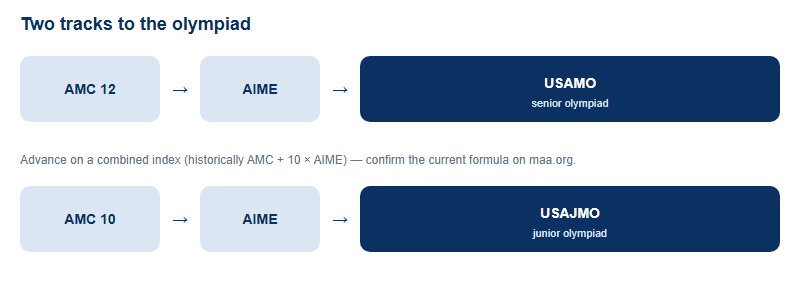
USAMO vs USAJMO: two tracks, two olympiads
The two olympiads are not different difficulty labels for one exam; they are the endpoints of two separate tracks. If you qualified for the AIME through the AMC 12, the senior olympiad you can be invited to is the USAMO. If you qualified through the AMC 10, the junior olympiad is the USAJMO. The junior route exists so that younger, strong students compete against peers on a comparable footing rather than against the most experienced twelfth-graders.
Selection used to run on a combined index that blended your AMC and AIME performance — historically the AMC score plus ten times the AIME score. That is the mechanism MAA is retiring, and this section corrects what we published earlier. For 2027, MAA states that USAMO and USAJMO qualification “will be primarily based on AIME scores; AMC scores will no longer be a factor in qualification.” The complete criteria have not been posted yet. Until those are published, the responsible statement is that the AIME score is the primary input and the AMC score is not one — not a specific formula, which nobody outside MAA currently has. Confirm the position on maa.org.
The index has a practical consequence worth internalising: because it weights the AIME heavily, the AIME — not the AMC — usually does the real deciding for olympiad selection. A student with a solid-but-not-spectacular AMC score can still reach the olympiad on the strength of a strong AIME, while a brilliant AMC alone will not carry a weak AIME. That is why serious olympiad hopefuls treat qualifying for the AIME as the beginning of the work, not the finish line, and why they keep pushing on AIME accuracy long after they have cleared the AMC.
| Track | Qualifying route | National olympiad | Typical student |
|---|---|---|---|
| Senior | AMC 12 → AIME | USAMO | Grades 11–12, or advanced younger students aiming at the top |
| Junior | AMC 10 → AIME | USAJMO | Grade 10 and below on the junior route |
What the olympiad exam actually looks like
This is the moment the competition changes character. The AMC is multiple choice; the AIME asks for integer answers with no working shown. The USAMO and USAJMO ask for something different again: complete, rigorous proofs. You are not filling a bubble or writing a final number — you are writing an argument that convinces a human grader that your claim is true beyond doubt.
The exam is commonly set as six problems split across two days, with three problems per day and several hours per session. Each problem is scored on a scale that rewards partial progress, so a well-structured attempt that stops short of a full solution can still earn marks — a sharp contrast to the all-or-nothing AMC. Because formats can be adjusted, confirm the current structure and timing on maa.org rather than assuming last year's details still hold.
Grading is worth understanding in advance because it changes your strategy. Each problem is commonly scored out of 7 points, with marks awarded for genuine, correct progress toward a full solution rather than only for a finished proof — so a clean write-up of the argument you do have is never wasted. Confirm the current scoring scale on maa.org. The lesson many first-timers learn the hard way is that a half-solved problem, written up rigorously and legibly, can outscore a nearly-complete one that is presented as a tangle the grader cannot follow.
The practical takeaway: the skills that carried you through the AMC and AIME — speed, pattern recognition, careful arithmetic — are necessary but no longer sufficient. Proof writing is its own discipline. You need to state definitions cleanly, handle every case, justify each step, and present the whole thing so a stranger can follow it. Many students who are fast and accurate on multiple choice find the first olympiad a humbling experience precisely because writing is harder than answering.
How you actually get there from the AMC
The realistic path has no shortcuts. You clear the AMC first — in 2026 that means an in-person sitting at an authorized center, as described in our 2026 in-person AMC rules. You then need to qualify for the AIME — a fixed 100 on the AMC 10 or 85 on the AMC 12 for 2027 — and score well enough on the AIME itself. Only then does the invitation arrive.
It also helps to be realistic about time. Almost no one goes from a first AMC to an olympiad invitation in a single season. Strong students typically spend one or more years becoming reliable on the AMC, another building AIME-level speed and accuracy, and more still learning to write proofs to olympiad standard. If you are early in high school, that is good news: it means starting now — even far from the qualifying line — is exactly the right move, because the proof-writing rung is the slowest to build and the hardest to rush.
Along the way, the single most under-practiced skill is proof writing, and it is the one you can start building long before you are within reach of an invitation. A few habits pay off:
- Read solutions like a writer, not a spectator. When you study an official or published solution, notice how the argument is organized — what is assumed, what is proved, and in what order.
- Write full solutions to AIME-level problems. Even when the answer is a single integer, force yourself to justify it in complete sentences. This trains the muscle you will need later.
- Get your proofs read. A proof that convinces you is not the same as a proof that convinces a grader. Feedback from a stronger reader closes that gap faster than solo practice.
- Build breadth in the classic olympiad areas. Number theory, combinatorics, geometry, and inequalities each have their own toolkit. Depth in one area rarely rescues a paper that spans all four.
What reaching it signals — and what it does not
Being invited to the USAMO or USAJMO is genuinely rare, and it is a strong signal of mathematical maturity: it says you can not only solve hard problems but also prove your solutions. Above the olympiad, the top performers are invited to the MAA's summer training program, and from that pool the United States team for the IMO is chosen. Those are extraordinary achievements reached by a very small number of students each year.
Be clear-eyed about what it is and is not, though. No competition result guarantees university admission, and it should never be pursued as a single golden ticket. It is one strong data point inside a wider academic profile. For most students — including strong ones — the greater value lies in the climb itself: the AMC and AIME rungs build durable problem-solving skill even if the olympiad invitation never comes.
A first-party note for students in China's international schools: exam-oriented preparation tends to over-train speed and under-train written argument, which is exactly the skill the olympiad demands. If the olympiad is a serious goal, start writing proofs early — well before you are close to qualifying — because that is the rung where progress is slowest to build and hardest to fake.
Frequently asked questions
What is the difference between the USAMO and the USAJMO?
Both are proof-based national olympiads. The USAMO sits on the AMC 12 (senior) track and the USAJMO on the AMC 10 (junior) track. Confirm details on maa.org.
How do you qualify for the USAMO or USAJMO?
You clear the AMC, qualify for and sit the AIME, then score well enough on the AIME. For 2027 MAA says qualification will be primarily based on AIME scores and that AMC scores are no longer a factor. Full criteria are still to be posted on maa.org.
Are the olympiads multiple choice like the AMC?
No. The USAMO and USAJMO ask for full written proofs, commonly six problems over two days. Confirm the current format on maa.org.
Does reaching the USAMO guarantee university admission?
No. It is a rare, strong signal of mathematical maturity, but no competition guarantees admission. Treat it as one part of a wider profile.
This is an independent English-language guide operated by Hanlin Education for China-based international-school students. It is not affiliated with, endorsed by, or sponsored by the Mathematical Association of America (MAA). Competition formats, dates, and selection rules change — always confirm current details on maa.org. We correct any error within 7 working days.