The American Mathematics Competitions are built from four content pillars — algebra, geometry, number theory, and combinatorics (counting and probability). Knowing roughly how each pillar shows up at the AMC 8, AMC 10, and AMC 12 levels lets you study by topic instead of grinding random problem sets. The mix is not fixed year to year, but the broad shape is stable: the AMC 8 leans on arithmetic and counting, the AMC 10 broadens into real contest algebra and geometry, and the AMC 12 adds trigonometry and advanced algebra on top.
The four pillars, and why they matter more than topics
Almost every AMC problem can be sorted into one of four families. Strong competitors think in these families because each rewards a different habit of mind, and weakness in any one caps your ceiling: you cannot brute-force a combinatorics gap with algebra skill.
| Pillar | Core ideas | The habit it trains |
|---|---|---|
| Algebra | Equations, functions, sequences, inequalities, polynomials | Symbolic manipulation and setting up the right unknowns |
| Geometry | Triangles, circles, area, similarity, coordinate geometry | Seeing structure in a figure and choosing a clean tool |
| Number theory | Divisibility, primes, modular arithmetic, digits, factors | Reasoning about integers and remainders |
| Combinatorics | Counting, probability, casework, the pigeonhole idea | Organising possibilities without double-counting |
The exact number of questions from each pillar varies per paper and is set by the MAA, so treat any breakdown as a planning guide rather than a guarantee — the official problem sets on maa.org are the authoritative record of what was tested.
How the mix shifts from AMC 8 to AMC 12
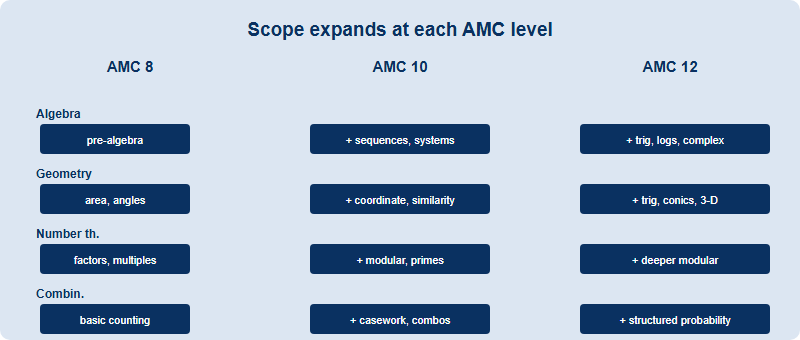
The single most useful insight for a China-based student is that the AMC is not three harder versions of one syllabus — the content range genuinely expands at each level. Here is the broad picture, with topics framed by what each exam assumes you have learned.
| Level | Algebra | Geometry | Number theory | Combinatorics |
|---|---|---|---|---|
| AMC 8 (grade 8 & below) |
Pre-algebra, ratios, basic equations | Area, perimeter, angles, basic 3-D | Factors, multiples, simple divisibility | Direct counting, basic probability |
| AMC 10 (grade 10 & below) |
Elementary algebra, sequences, systems — no trig | Plane & coordinate geometry, similarity | Modular arithmetic, primes, digit problems | Casework, combinations, expected value |
| AMC 12 (grade 12 & below) |
Advanced algebra, logs, complex numbers, trigonometry | Trig in geometry, conics, more 3-D | Deeper modular & number-theoretic ideas | Harder counting, probability with structure |
Two boundaries are worth memorising because students cross them at their peril. First, the AMC 10 deliberately excludes trigonometry and the most advanced algebra; the AMC 12 includes both. Second, neither exam tests calculus — an early calculus head start does not, by itself, raise your AMC ceiling. If you want help deciding which exam matches your current course progress, see our AMC 10 vs AMC 12 decision guide.
What to actually study in each pillar
A focused checklist beats a vague “do more problems.” For an AMC 10/12 candidate, these are the high-leverage skills inside each family — the topics that recur and reward the most practice time.
- Algebra: Vieta's formulas for sums/products of roots; manipulating sequences and series; clever substitution; inequalities (AM–GM at the AMC 12 level); on the AMC 12, comfort with logarithms, complex numbers, and trigonometric identities.
- Geometry: similar triangles and the power of a well-placed auxiliary line; area ratios; coordinate geometry as a fallback when synthetic geometry stalls; circle theorems; on the AMC 12, the law of sines/cosines and trig area formulas.
- Number theory: divisibility rules and the structure of factors; modular arithmetic (especially mod 9, 10, 11 for digit problems); greatest common divisor and least common multiple; counting divisors from prime factorisation.
- Combinatorics: systematic casework without double-counting; combinations and the binomial coefficient; complementary counting; basic expected value; recognising when a probability question is really a counting question.
The first-party rule we use with students: diagnose your weakest pillar first, then weight your practice toward it. Most plateaus are not a general “get smarter” problem — they are one specific family (very often combinatorics or number theory for students from a procedure-heavy curriculum) dragging the score. A balanced four-pillar competitor outscores a lopsided one with the same raw ability.
A topic-first study sequence
Studying by pillar turns an overwhelming syllabus into a finite checklist. A workable order of operations:
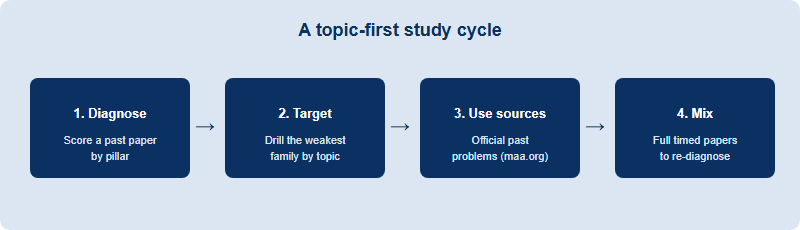
Anchor every block to official past papers rather than imitations, because the genuine MAA problems are the only fully reliable signal of the exam's real style, difficulty curve, and topic mix. For a deeper look at the foundational sequence and where these exams sit, browse the US AMC guide. And as always, keep the three AMCs straight: this is the MAA's American Mathematics Competitions, distinct from the Australian AMC (AMT) and from AMO (SIMCC, Singapore), which have their own syllabuses.
Frequently asked questions
What topics are on the AMC 10 but not the AMC 8?
The AMC 10 broadens into real contest algebra, coordinate geometry, modular arithmetic, and structured combinatorics, while the AMC 8 stays at pre-algebra and basic counting.
Is trigonometry tested on the AMC 10?
No. Trigonometry first appears on the AMC 12; the AMC 10 deliberately excludes it and the most advanced algebra. Confirm the current syllabus on maa.org.
Does the AMC test calculus?
No. Neither the AMC 10 nor the AMC 12 tests calculus, so an early calculus start does not by itself raise your AMC ceiling.
Which pillar should I study first?
Diagnose with a past paper scored by pillar, then weight practice toward your weakest family — often number theory or combinatorics for procedure-heavy backgrounds.
This is an independent English-language guide operated by Hanlin Education for China-based international-school students. It is not affiliated with, endorsed by, or sponsored by the Mathematical Association of America (MAA). The syllabus, topic mix, and all competition rules are defined by the MAA and vary per cycle — confirm current details and the official problem sets on maa.org. We correct any factual error within 7 working days.