Being at the top of your AP, IB, or A-Level maths class does not automatically make you ready for the AMC. School mathematics and competition mathematics are two different sports. Your school course measures how well you execute a defined syllabus; the AMC measures how fast you can attack unfamiliar, non-routine problems — with no calculator, no partial credit, and, notably, no calculus required. This guide explains why that gap exists and how international-school students can bridge it.
Two different sports
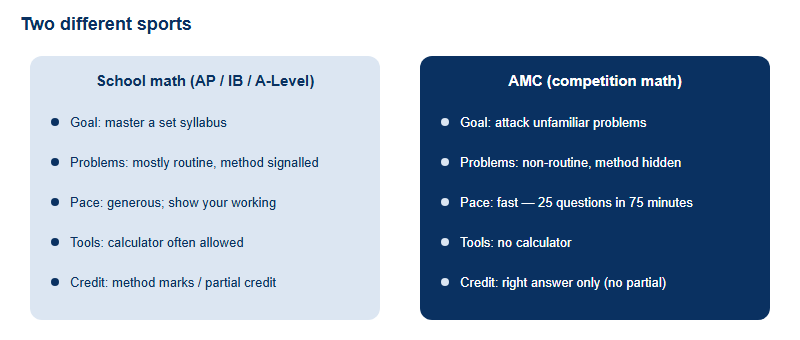
The clearest way to understand the AMC is to stop thinking of it as a harder version of your school exam. It is a different kind of test with different goals. A curriculum assessment is designed to check whether you have learned a body of content and can apply taught methods; it rewards clear working and usually gives credit for a correct method even if the final number is wrong. The AMC is designed to separate strong problem-solvers under time pressure. The method is hidden, the clock is tight, and only the final answer counts.
What carries over — and what doesn't
Plenty of your school training does transfer. Fluent algebra, comfort with functions and graphs, and solid geometry are the raw materials of most AMC problems, and a student who has none of that will struggle. On the AMC 12 specifically, the exam draws on the upper end of the pre-calculus syllabus — trigonometry, logarithms, and complex numbers — so those topics are directly useful rather than extra baggage. The AMC 10 stays below that ceiling.
The important correction is what is missing from most curricula. School courses are usually thin on number theory and on serious counting and probability — two areas the AMC leans on heavily. A student can ace their school exams and still meet an AMC number-theory problem having never seen the idea it depends on. And crucially, none of the AMC requires calculus; a strong AP Calculus grade does not, on its own, buy you AMC points, because the exam simply is not built on calculus.
A concrete example makes the gap tangible. A counting problem might ask how many arrangements avoid a certain condition. The school instinct is to count the arrangements that satisfy it directly — often a mess of overlapping cases. The competition idea, complementary counting, flips the problem: count every arrangement, subtract the ones you do not want, and a hard problem becomes two easy ones. That move is not on most syllabuses, yet it unlocks a whole family of AMC questions. Competition math is full of such reframings, and quietly collecting them is a large part of the work.
| What school math builds | How it helps on the AMC | The gap to close |
|---|---|---|
| Algebra fluency | Fast manipulation of expressions and equations | Non-routine setups and clever substitutions |
| Geometry basics | Angles, area, and similarity foundations | Configuration-hunting and auxiliary constructions |
| Trig, logs, complex numbers | Directly tested on the AMC 12 | Applying them at speed, under the clock |
| Number theory and counting | Rarely core in school syllabuses | Often must be learned largely from scratch |
The format shock
Even before the mathematics, the format catches students off guard. The AMC 10 and AMC 12 are 25-question, 75-minute multiple-choice papers with five answer choices. There is no calculator. The scoring is designed so that a blank is worth 1.5 points while a wrong answer is worth 0 — which means the exam quietly rewards knowing when not to answer, a decision you almost never make in a school test. Always confirm the current scoring and rules on maa.org for your cycle.
There is a further wrinkle for 2026: the AMC is offered in person at authorized test centers, on paper, rather than through a device you might be used to for mock exams at school. The practical logistics — registration, what a center looks like, what you can bring — are covered in our 2026 in-person AMC guide. If your school exams have trained you to lean on a graphing calculator and to expect method marks, the AMC removes both crutches at once. Practising in the real format — timed, on paper, no calculator — is not optional; it is part of the preparation.
The absence of partial credit also changes what “checking your work” means. In a school exam, a small slip late in a long method might still earn most of the marks. On the AMC, one arithmetic error turns a 6-point answer into a 0, so a fast sanity check — does this answer even make sense in size and sign? — is worth far more than students trained on method marks expect. Building that reflex is as much a part of AMC preparation as learning new topics.
The real gap: routine vs non-routine problems
Strip away the format differences and the deepest gap is about the type of problem. A school question usually tells you, directly or through the chapter it appears in, which method to use: this is a quadratic, so complete the square; this is a related-rates problem, so differentiate. The work is in the execution. An AMC problem deliberately hides the method. Half the challenge is recognising, from a bare situation, which idea unlocks it — and the surface of the problem is often designed to point you at the wrong one.
This is why fast, accurate students sometimes stall on their first AMC. They have trained execution, not selection. The fix is not more of the same drilling; it is deliberate exposure to unfamiliar problems so that pattern-recognition becomes a skill in its own right. Over time you build a mental library: “this smells like a pigeonhole argument,” “this counting problem is cleaner with complementary counting,” “this geometry configuration wants a well-placed auxiliary line.” That library is exactly what school math, however advanced, does not systematically build.
You can train selection deliberately. The trick is to practise on mixed sets — problems not grouped by topic — so you cannot guess the method from the chapter heading. Full past papers do this for you automatically: question 14 gives no hint whether it is geometry, number theory, or counting. Over enough mixed practice, your first instinct on seeing a problem sharpens from “I have no idea where to start” to “this looks like a job for parity,” and that first instinct is most of what separates a plateaued scorer from an improving one.
How to bridge the gap
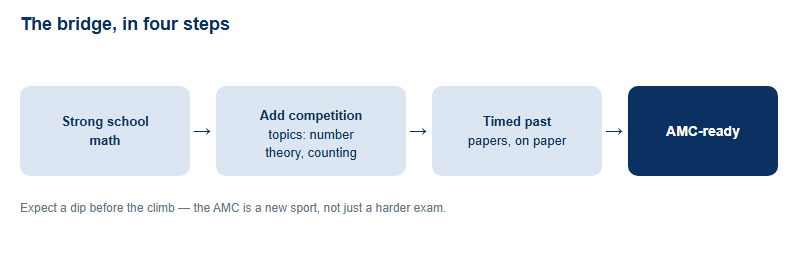
The good news is that the bridge is well-marked, and your school foundation is a real head start. A workable plan looks like this:
- Fill the topic gaps first. Add the areas curricula under-cover — introductory number theory and systematic counting — and, if you are aiming at the AMC 12, make sure trigonometry, logarithms, and complex numbers are fluent.
- Practise in the real format. Do full, timed past papers on paper without a calculator, matching the 2026 in-person AMC conditions, so the format stops being a shock and becomes routine.
- Build a non-routine toolkit. Study solutions for the ideas, not just the answers, and keep a short list of recurring tactics you can reach for.
- Expect a dip. Many strong school students score lower than they expect at first. That is normal and not a verdict on your ability — it is the sport being new.
Set expectations by process, not by a target score. There is no reliable formula that converts a given number of practice hours into a specific AMC result, and comparing yourself to the score reports people post online is a fast route to discouragement. A better measure of progress is whether problems that used to look impossible now look merely hard. Even students who never reach the highest tiers come away with something durable: the habit of attacking an unfamiliar problem calmly instead of freezing — a skill that outlasts any single competition.
A first-party note for students in China's international schools: the AMC actually rewards the very habits that busy IB, AP, and A-Level students can neglect — curiosity about problems with no obvious method, and the patience to sit with something unfamiliar. If you treat the AMC as a second syllabus to memorise, it will fight you. If you treat it as a chance to learn how to think, your school math becomes the foundation it was always meant to be.
Frequently asked questions
Do I need calculus for the AMC?
No. The AMC is built on pre-calculus topics; the AMC 12 uses trigonometry, logarithms, and complex numbers, but calculus is not required. Confirm on maa.org.
Will being good at AP, IB, or A-Level math make me good at the AMC?
It helps with core algebra and geometry, but the AMC adds non-routine problems and topics like number theory and counting that school courses under-emphasize.
Can I use a calculator on the AMC?
No. Calculators are not permitted on the AMC 10/12, unlike many school exams. In 2026 the exam is on paper at authorized centers. Confirm rules on maa.org.
How long does it take to bridge the gap?
It varies by student and starting point. Plan for a dip at first, then steady gains from timed past-paper practice. There is no guaranteed timeline.
This is an independent English-language guide operated by Hanlin Education for China-based international-school students. It is not affiliated with, endorsed by, or sponsored by the Mathematical Association of America (MAA). Competition formats, dates, and rules change — always confirm current details on maa.org. We correct any error within 7 working days.