The US AMC 10 and AMC 12 hand out several layers of recognition — Honor Roll, Distinguished Honor Roll, Achievement Roll, Certificates of Achievement, and school-level awards — and almost all of them are defined by percentile, not by a fixed score. That is why last year’s cutoff tells you very little about this year’s. This guide decodes each tier, explains why the numbers move, and translates it into realistic targets for an international-school student aiming at the AIME.
The one idea that explains everything: percentile, not points
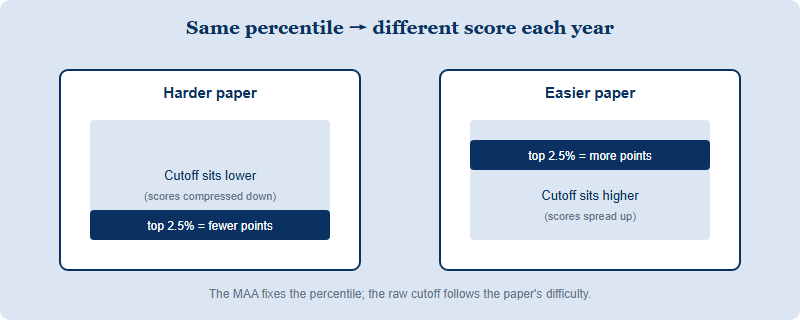
The Mathematical Association of America (MAA) sets AMC recognition and the AIME invitation by where you land among all scorers, then translates that percentile into a score cutoff after the competition is written and graded. Because some papers are harder than others, the same percentile corresponds to a different raw score each year. So a score that qualified for the AIME on one paper might miss on an easier one, and vice versa.
This is the single most misunderstood part of the AMC. The takeaway: chase a percentile target and consistent accuracy, not a specific number you saw in a forum. Always read the official cutoffs from the MAA’s post-competition statistics on maa.org rather than assuming a value.
The recognition tiers, one by one
Here is what each AMC 10/12 recognition means, based on the MAA’s stated criteria. Note that “Honor Roll” and the AIME invitation are the same threshold — being invited to the AIME is the Honor Roll recognition.
| Recognition | AMC 10 criterion | AMC 12 criterion | What it signals |
|---|---|---|---|
| Honor Roll (= AIME invite) | Top 5% (see note on the AIME line below) | Approx. top 5% of scorers | You have qualified for the next round, the AIME |
| Distinguished Honor Roll | Approx. top 1% of scorers | Approx. top 1% of scorers | Elite tier — well inside the AIME field |
| Achievement Roll | — | Grade 10 & below scoring 90+ on the AMC 12 | Recognises younger students taking the AMC 12 early |
| Certificate of Achievement | Available for strong AMC 8 performance in the family of awards | — | Encouragement/recognition certificate |
A few clarifications students frequently get wrong:
- Honor Roll and AIME qualification have come apart. They used to be the same line. For 2027 MAA has moved AIME qualification onto fixed scores — 100 on the AMC 10, 85 on the AMC 12 — while Honor Roll remains a percentile band. Treat them as two separate things from now on, and note this corrects what our earlier guidance said.
- Distinguished Honor Roll is the same ~top 1% on both exams. The AIME threshold differs between AMC 10 and 12 (2.5% vs 5%), but the Distinguished tier is roughly the top 1% for each.
- Achievement Roll is age-based recognition. It specifically honours students in grade 10 and below who score 90 or above on the AMC 12 — a way to flag younger students punching above their grade.
School-level recognition
Beyond individual awards, the MAA recognises schools by team strength, which many families overlook. For the AMC 12, the school team score is the sum of its top three students’ scores:
- School Honor Roll — awarded to schools with a team score of 400 or greater.
- School Merit Roll — awarded to schools with a team score between 300 and 399, inclusive.
For an international school building a maths programme, these team awards are a concrete, verifiable milestone — and they reward depth (three strong students) rather than a single star. If your school runs an AMC cohort, tracking the top-three combined score gives coaches a clear target. Confirm the current team-award thresholds on maa.org, as school-recognition rules can be updated.
Turning tiers into realistic targets
Because cutoffs float, the smartest way to set goals is by question reliability rather than a fixed final number. On a 25-question paper scored +6 correct / +1.5 blank / 0 wrong (max 150), here is a way to think about the ladder:
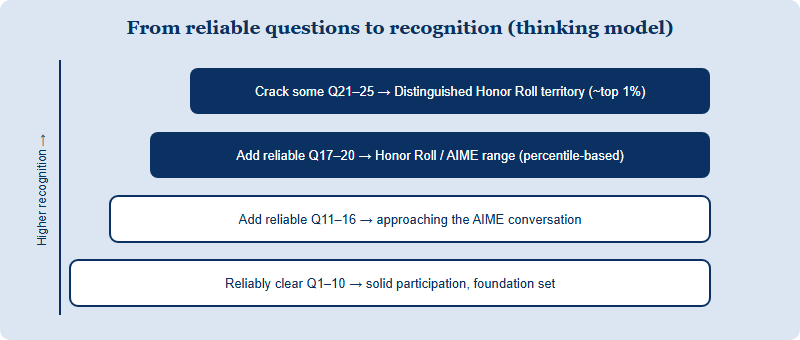
This ladder is deliberately framed around which questions you can solve reliably because that is the part you control. You cannot control how hard this year’s paper is or where the cutoff lands, but you can control whether Q1–18 are automatic for you. Students who make the early and middle questions bulletproof — zero careless errors — put themselves in AIME range on almost any paper, because those questions carry the bulk of the achievable points. Our companion piece on the US AMC pathway hub covers how this feeds into the AIME and USA(J)MO rounds.
Three comparisons that mislead students every year
Because the recognition system is percentile-based and runs on two competition dates, students constantly draw the wrong conclusions from score comparisons. Three traps in particular:
- Comparing across the A and B dates. The AMC 10/12 run on two dates (A and B) with different papers. A friend’s raw score on the A date is not directly comparable to yours on the B date — each date has its own difficulty and its own cutoff. What matters is your standing among scorers on your paper.
- Comparing to last year’s cutoff. “The AIME cutoff was X last year, so I’m safe” is exactly the reasoning the floating system breaks. Last year’s number reflects last year’s paper. Treat prior cutoffs as rough context, never as a promise.
- Comparing AMC 10 and AMC 12 scores head-to-head. These are different exams with different AIME thresholds (100 versus 85 for 2027). A given raw score means different things on each, so a 12’s score and a 10’s score are not on the same ladder.
The healthy mindset is to stop benchmarking against individual friends’ numbers and instead ask: on a paper of unknown difficulty, am I reliably solving enough of the early and middle questions to land in my target percentile? That question survives every year’s variation. Once official statistics are published on maa.org, you can see exactly where you fell — but the preparation target should always be percentile and reliability, set in advance.
A quick note on certificates and how recognition reaches you
Recognition is typically confirmed after the MAA processes results and releases official statistics; certificates for the various rolls are issued through the AMC programme rather than appearing instantly on test day. Schools that register and administer the exam are the usual channel through which students receive their standing and any certificates. If you sat the exam through a registered centre or your school, that is where confirmation of Honor Roll, Distinguished Honor Roll, or Achievement Roll status will come from. Exact timing and delivery can vary year to year, so check maa.org and confirm with your test centre rather than assuming a date.
What the awards mean for admissions — honestly
AMC recognition is a genuine, widely respected signal of mathematical ability, and reaching Honor Roll (AIME qualification) or Distinguished Honor Roll is a meaningful line on a strong STEM application. But be precise about it: an award is evidence of ability, not a guarantee of any admissions outcome. Universities read it in context alongside everything else. Present it accurately — the tier you earned, the year, and the exam — and let it speak for itself. Overstating a percentile or implying a cutoff you did not verify undermines the credibility the award is meant to give you.
What the tiers look like across one coached cohort
The cut-off discussion above is easier to hold onto against a real group. Here is the 2025-26 record for the cohort this desk coached — our own data, per Hanlin, not MAA statistics, and a self-selected group rather than a random sample.
| Stage | Cohort outcome (2025-26) |
|---|---|
| AMC 10 | 379 AIME qualifications (counting sittings, not distinct students); 165 in the global top 5%; 13 in the global top 1%; 5 perfect scores; 35 scored 140+; 176 scored 120+ |
| AIME | 42 students scored 10 or above; one perfect 15 on AIME II |
| Beyond | 6 students reached the USA(J)MO |
Read the middle row, not the first. AIME qualification is common inside a prepared cohort; scoring 10+ on the AIME is not — and the gap between those two rows is where the real difficulty of the ladder sits. The count that shrinks fastest is the one nearest the top: from hundreds of qualifications, to dozens of double-digit AIME scores, to a single-figure number reaching the USA(J)MO. That taper is the honest version of what a tier means.
Frequently asked questions
Is there a fixed AMC score that qualifies for the AIME?
For 2027, yes — and this reverses the position we described earlier. MAA has replaced the percentile band with fixed thresholds of 100 on the AMC 10 and 85 on the AMC 12. The award rolls (Honor Roll, Distinguished Honor Roll) remain percentile-based, so the two lines are no longer the same.
Is Honor Roll different from qualifying for the AIME?
No. On the AMC 10/12, Honor Roll recognition and the AIME invitation are the same threshold — being invited to the AIME is your Honor Roll standing.
What is the Achievement Roll?
It recognises students in grade 10 and below who score 90 or above on the AMC 12, honouring younger students who perform strongly on the harder exam. Confirm the criterion on maa.org.
How do school awards work?
The AMC 12 team score is the top three students’ scores combined; roughly, 400+ earns School Honor Roll and 300–399 earns School Merit Roll. Verify current thresholds on maa.org.
This is an independent English-language guide operated by Hanlin Education for China-based international-school students. It is not affiliated with, endorsed by, or sponsored by the Mathematical Association of America (MAA). Formats, dates, scoring, award criteria, and eligibility can change year to year; always confirm current details on the official site, maa.org. Any error will be corrected within 7 working days.