Moving from the AMC 8 to the AMC 10 is not just “harder questions.” It is a change in the whole game: the scoring rewards restraint instead of speed, the topic list adds algebra and geometry that the AMC 8 barely touches, and the last third of the paper is built to stop even fast eighth-graders. If your child aced the AMC 8, the AMC 10 will still feel unfamiliar for the first few months — and that is normal. This guide breaks down exactly what changes and how to bridge it.
What actually changes between the two exams
The AMC 8 and AMC 10 are both produced by the Mathematical Association of America (MAA), part of the US American Mathematics Competitions pathway (AMC 8 → AMC 10/12 → AIME → USA(J)MO). But their structure differs in ways that reshape how you should prepare. Confirm current-year specifics on maa.org, as the MAA can adjust details year to year.
| Dimension | AMC 8 | AMC 10 | What it means for you |
|---|---|---|---|
| Questions | 25 | 25 | Same count, very different tail difficulty |
| Time | 40 minutes | 75 minutes | ~3 min/question vs ~1.6 min on AMC 8 — depth over speed |
| Scoring | 1 point per correct, no penalty for blanks or wrong | +6 correct, +1.5 for a blank, 0 for wrong | On AMC 10, a blank can beat a wild guess |
| Max score | 25 | 150 | Every question is worth 6 — one careless slip is costly |
| Calculator | Not permitted | Not permitted | Mental/paper arithmetic stays essential |
| Audience | Grade 8 and below | Grade 10 and below | Younger students can and do sit the AMC 10 early |
The single biggest structural shift is the scoring. On the AMC 8, guessing costs nothing, so filling every bubble is correct strategy. On the AMC 10, a blank is worth 1.5 points and a wrong answer is worth 0. That means once a student has answered enough questions confidently, the mathematically optimal move on a genuinely unknown question can be to leave it blank rather than guess — the opposite instinct from AMC 8. Absorbing this reversal is the first mental hurdle.
The topic gap: what the AMC 10 adds
The AMC 8 lives mostly in arithmetic, counting, basic number theory, and pre-algebra reasoning. The AMC 10 keeps all of that but layers on secondary-school content that an eighth-grader may not have seen in class yet. The competition assumes no calculus and no trigonometry beyond the basics, but it goes deep within the topics it does cover.
- Algebra: quadratics, systems, functional relationships, sequences and series, clever substitution. This is the biggest single addition versus the AMC 8.
- Geometry: similar triangles, power of a point, area ratios, coordinate geometry, and 3D solids — often the hardest cluster for students coming up from the AMC 8.
- Number theory: modular arithmetic, divisibility rules used at speed, Diophantine-style reasoning.
- Combinatorics: casework, complementary counting, and the pigeonhole principle, framed in less obvious ways than AMC 8 counting problems.
A student who has “finished” AMC 8 material has usually seen the topic names on the AMC 10 but not the competition-level depth. The gap is not vocabulary; it is fluency under pressure. For a fuller map of where each contest sits, see our US AMC guide hub.
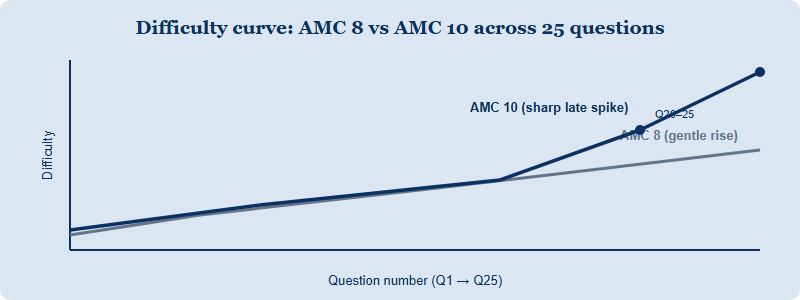
The tail is a different animal
On the AMC 8, the last few questions are challenging but stay within reach of a well-prepared strong student. On the AMC 10, questions roughly in the Q20–25 range are designed to separate serious contest students. Many capable students correctly solve Q1–15, slow down through Q16–19, and simply run out of time or ideas at the top end. That is by design — and it reframes what a “good score” looks like.
A realistic first-year AMC 10 goal for a student fresh off a strong AMC 8 is often consistent accuracy on the first 15–18 questions, not solving all 25. The AIME invitation threshold changed for 2027, and it changed in the direction that helps planning: MAA has replaced the percentile band with a fixed score of 100 out of 150 on the AMC 10 (85 on the AMC 12). That is a target you can actually train toward, rather than a line that moves with each paper. MAA says full AIME policies are still to be posted, and candidates in the international programme should follow their regional Group Leader.
A bridge plan, not a leap
The most common mistake is treating the AMC 10 as “AMC 8 but do more problems faster.” The scoring and topic depth both push against pure speed. A steadier bridge:
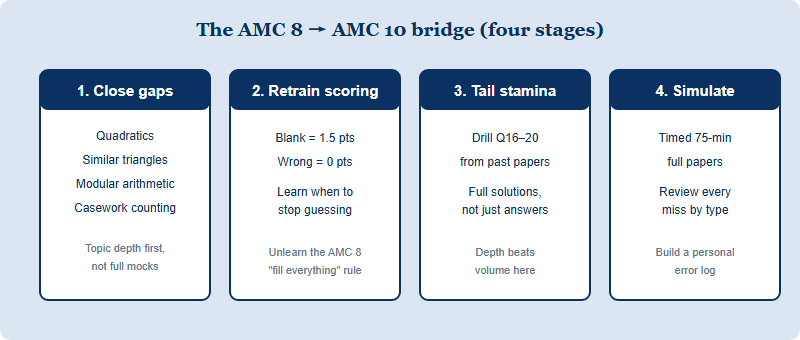
Stage 1 — Close topic gaps. Before any timed mocks, spend weeks on the AMC 10–specific topics your class has not reached: quadratics, similar triangles, modular arithmetic, casework. Learn them properly rather than skimming.
Stage 2 — Retrain scoring instincts. Practise deciding, mid-paper, whether an unknown question is worth attempting. The habit to build: answer confidently, then treat truly unfamiliar questions as candidates to skip rather than guess.
Stage 3 — Build tail stamina. Work Q16–20 from official past papers slowly, reading full solutions to absorb the recurring techniques, not just checking the letter answer.
Stage 4 — Simulate. Only near the end do full, timed 75-minute papers, followed by an error review that sorts each miss into “didn’t know the topic,” “knew it but too slow,” or “careless.” That log tells you where the next weeks go.
Should a young student sit the AMC 10 early?
The AMC 10 is open to students in grade 10 and below, so a strong grade 7–9 student is eligible. Sitting it early can be valuable as calibration — it shows exactly which topics and difficulty tiers are still out of reach, with no downside beyond the registration effort. The key is to treat an early attempt as diagnostic information, not as a verdict. A modest first score followed by a targeted year of the bridge plan is a completely normal trajectory toward AIME qualification.
Note the eligibility distinction that matters later in the pathway: the AIME and USA(J)MO have their own rules, and USA(J)MO in particular has residency/enrollment requirements. If your longer-term aim is the olympiad round, confirm those on maa.org early rather than assuming they mirror the AMC’s open eligibility.
Frequently asked questions
Does a high AMC 8 score predict a high AMC 10 score?
Not directly. A strong AMC 8 shows good fundamentals, but the AMC 10 adds algebra and geometry depth and a much harder tail, so a transition period is normal.
Should my child guess on every AMC 10 question like on the AMC 8?
No. Blanks earn 1.5 points and wrong answers earn 0, so leaving a genuinely unknown question blank can score better than a random guess.
Is it worth sitting the AMC 10 in grade 7 or 8?
It can be, as a diagnostic. Early attempts reveal which topics and difficulty tiers still need work, with no real downside. Treat the score as feedback, not a verdict.
What AMC 10 score qualifies for the AIME?
For 2027 MAA has set a fixed threshold of 100 out of 150 on the AMC 10, replacing the old percentile band. Full policies are still to be posted on maa.org.
This is an independent English-language guide operated by Hanlin Education for China-based international-school students. It is not affiliated with, endorsed by, or sponsored by the Mathematical Association of America (MAA). Formats, dates, scoring, and eligibility can change year to year; always confirm current details on the official site, maa.org. Any error will be corrected within 7 working days.