Most AMC algebra questions are not asking you to do algebra. They are asking you to set it up. Once the setup is written, the manipulation is usually two or three lines that a competent Grade 9 student can do. That is why algebra is the block where careful students lose the most time and gain the most from training recognition rather than technique. This article maps the recurring families and the cue that identifies each.
Everything below assumes the published competition structure: the AMC 10 and AMC 12 are each a 25-question, 75-minute multiple-choice paper, sat in person at an authorised centre. If you have not yet read how the sitting itself works, start with our guide to the 2026 in-person AMC rules and authorised test centres, then come back to the content. Confirm current dates, scope and eligibility on maa.org.
Why “algebra” means something different here
School algebra is organised by technique: this chapter is factorising, that chapter is simultaneous equations, and the exercises at the end of the chapter are all solved by the technique you just learned. You never have to work out which tool to reach for, because the chapter heading told you.
An AMC paper deletes the chapter heading. A question sitting at position 8 might be a rates problem wearing the clothes of a geometry diagram, or a sequence problem phrased as a story about a savings account. The algebra you need is rarely harder than what a strong Grade 9 or Grade 10 student already owns. What is harder is that nobody tells you which of your fifteen tools applies, and the clock gives you roughly three minutes a question on average.
There is a second constraint that reshapes the subject: no calculator — confirm the current permitted-materials rules on maa.org before you sit. That is not a minor inconvenience. It means the problems are built so that the arithmetic collapses — the numbers were chosen so that something cancels. If you are three lines in and facing an ugly decimal, that is almost always evidence you took the wrong route, not evidence that you should push harder. Treat ugly arithmetic as a diagnostic signal.
Scope matters too. The AMC 10 works in elementary algebra and excludes trigonometry, logarithms and complex numbers; the AMC 12 keeps everything on the AMC 10 and adds those. Neither paper uses calculus. Confirm the current published scope on maa.org before you plan a syllabus against it — the AMC 12 extensions are a separate study block and we treat them separately.
Seven families and the cue that names each one
The classification below is our own editorial framework, built from how our teaching team groups the work we set. It is not an official MAA taxonomy and MAA does not publish topic weightings — do not treat the family list as a promise about how any particular paper is composed. Treat it as a way to make recognition automatic.
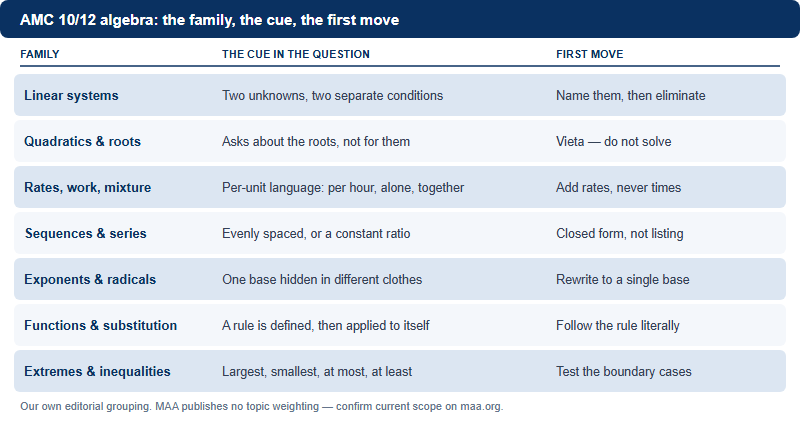
The facts you must be able to produce cold
Because there is no calculator and no formula sheet, a small number of identities have to be available instantly. Not “I could derive it” — available, in under two seconds, or the family recognition above buys you nothing.
| Fact | Statement | The question type it unlocks |
|---|---|---|
| Vieta, quadratic | For x² + bx + c = 0 with roots r, s: r + s = −b and rs = c | Anything asking for a symmetric expression in the roots |
| Square of a sum | r² + s² = (r + s)² − 2rs | Converts a Vieta pair into the thing actually asked for |
| Difference of squares | a² − b² = (a − b)(a + b) | Large-number arithmetic that looks impossible by hand |
| Arithmetic sum | Sum of n terms = n × (first + last) ÷ 2 | Any evenly spaced list, including counting problems |
| Geometric sum | Finite and infinite forms, with the ratio condition for convergence | Repeated-halving stories, repeating decimals |
| Exponent laws | (am)n = amn; am × an = am+n | Rewriting 8x, 4x, 9x in terms of a given power |
| Rate addition | Combined rate = sum of individual rates; time = 1 ÷ rate | Every pipe, painter and shared-work problem |
Notice how short that list is. The whole of AMC 10 algebra runs on roughly this much machinery plus careful reading. Students who feel behind in algebra are usually not missing content — they are missing fluency, and fluency is a drill problem with a known cure.
Four recognition drills
These are written for this article rather than taken from any paper, so you can use them without touching material you may want to save for timed practice. Give yourself ninety seconds each, and note which family you decided on before you note the answer.
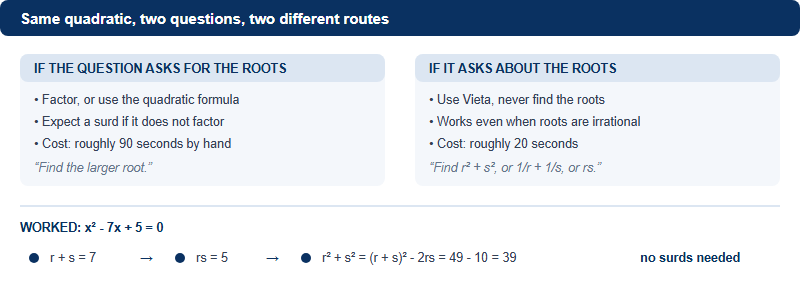
- Drill 1. The equation x² − 7x + 5 = 0 has roots r and s. Find r² + s². Family: quadratics & roots. The question asks about the roots, not for them, so Vieta applies: r + s = 7 and rs = 5, giving r² + s² = 49 − 10 = 39. Solving the quadratic gives irrational roots and wastes two minutes.
- Drill 2. A tank fills in 12 minutes through pipe A alone and 18 minutes through pipe B alone. With both open, how long? Family: rates. Add rates, not times: 1/12 + 1/18 = 5/36, so the time is 36/5 = 7.2 minutes. The classic error is averaging 12 and 18, which is wrong in a way that always produces a plausible-looking answer choice.
- Drill 3. An arithmetic sequence has first term 4 and twentieth term 61. Find the sum of the first twenty terms. Family: sequences. You do not need the common difference: 20 × (4 + 61) ÷ 2 = 650. Students who compute the difference first still get there, thirty seconds later.
- Drill 4. If 2x = 5, what is 8x? Family: exponents. Rewrite to one base: 8x = (2³)x = (2x)³ = 125. No logarithms required — the exponent laws finish it on their own.
The pattern across all four: the fast route came from reading what was being asked for, not from being better at algebra. Drill 1 is the cleanest example, and it is worth its own diagram.
Where algebra hides inside other topics
A study plan that puts algebra in its own box underestimates it, because a large share of algebra work on an AMC paper is not labelled as algebra at all.
- Inside geometry. A length is unknown, a similarity or a Pythagorean relation gives you an equation, and the last step is a quadratic. The geometry ends the moment the equation appears; everything after that is your algebra fluency.
- Inside counting. Many counting answers are built from an arithmetic series, or require you to solve for the value of n that makes a count equal to something. The combinatorial thinking gets you to an expression; algebra gets you to a number.
- Inside number theory. “Find all integers such that…” problems usually become an equation you factor and then test. Factoring is an algebra skill applied to an integer question.
The practical consequence: if your algebra fluency is weak, it does not cost you only the algebra questions. It taxes every question whose last two lines are algebraic — which, in our experience setting practice for China-based students, is where a surprising share of “careless” errors actually originate. The student did the hard thinking correctly and then lost the point in the routine part.
A four-week algebra block that fits the season
Algebra rewards short, dense, frequent work far more than long sessions. A defensible structure for a student who has already sat a baseline mock:
- Week 1 — fluency. Twenty minutes a day on the identity table above until each item is instant. Do not do full problems this week. The bottleneck is recall speed, and mixing in problem-solving hides whether recall is actually fixed.
- Week 2 — family labelling. Take thirty algebra-flavoured problems and, for each, write only the family and the first move. Do not solve them. This trains the exact skill the paper tests under time pressure, at roughly six times the throughput of solving.
- Week 3 — solve, then compare routes. Now solve the same thirty. For each, ask whether a shorter route existed. The shorter route is the lesson; the answer is not.
- Week 4 — mixed and timed. Algebra problems interleaved with other topics, because in the real paper nothing announces its family. Track only two numbers: how often you named the family correctly, and how often ugly arithmetic appeared. Both should be falling.
Two practical notes for students sitting in China. First, this block assumes you have a confirmed seat: registration for the AMC runs through schools, universities, math circles and learning centres rather than individual sign-up, so the seat needs sorting before the study plan matters — our walkthrough of the in-person sitting requirements covers what to check. Second, when you write your own notes, keep them in the notation the paper uses; switching between a Chinese textbook’s conventions and the paper’s is a small tax you pay repeatedly under time pressure.
Frequently asked questions
Is algebra the biggest topic on the AMC 10?
MAA does not publish topic weightings, so nobody can honestly give a percentage. Prepare across all topics and confirm scope on maa.org.
Do I need logarithms for AMC 10 algebra?
MAA does not name logarithms in its published scope. It describes the AMC 10 as excluding trigonometry, advanced algebra and advanced geometry, and the AMC 12 as covering the full high school curriculum including those. Confirm the current published scope on maa.org.
Can I use a calculator for the arithmetic?
No. The papers are sat without a calculator, which is why well-built problems always simplify. Confirm permitted materials on maa.org.
How long is the paper?
The AMC 10 and AMC 12 are each 25 questions in 75 minutes, roughly three minutes per question on average, sat in person at an authorised centre.
This is an independent English-language guide operated by Hanlin Education for China-based international-school students. It is not affiliated with, endorsed by, or sponsored by the Mathematical Association of America (MAA). The family classification and study block above are our own editorial framework, not official MAA guidance. Competition dates, eligibility, scope and rules change from year to year — always confirm current details on maa.org before making decisions. If you spot an error, tell us and we will correct it within 7 working days.