Number theory is the best-value block on the AMC because the toolkit is finite. Geometry can surprise you with a configuration you have never seen; number theory nearly always reduces to one of a small number of recurring setups — divisor counts, greatest common divisors, remainders, digits, integer solutions — and the AMC 12 adds a short list of extensions on top. Learn to recognise the family and the first move is usually forced.
This article maps those families, states the facts you must be able to produce without a calculator, and works three short recognition drills written for this article rather than lifted from any paper. The syllabus descriptions used below follow how our teaching team reads the published scope; confirm current wording, eligibility and dates on maa.org.
What the syllabus actually promises
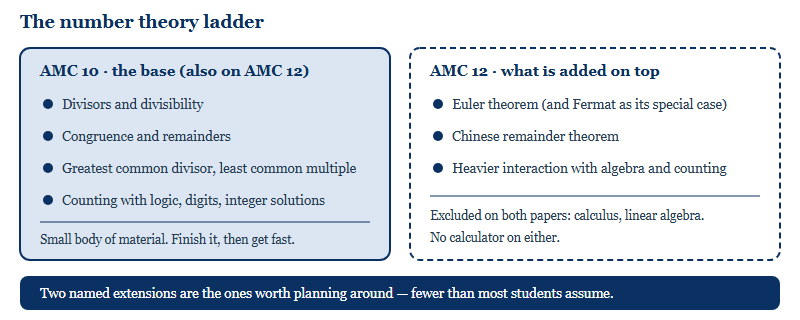
The two papers do not cover the same number theory, and the difference is specific rather than vague.
The AMC 10 works in elementary number theory: divisors and divisibility, congruence, and the counting-and-logic problems that sit alongside them. That is a genuinely small body of material. A motivated student can cover all of it in a few weeks and then spend the remaining time getting fast.
The AMC 12 keeps all of that and adds further number theory — Euler’s theorem and the Chinese remainder theorem are the two named extensions worth planning around. Both papers exclude calculus and linear algebra, so no amount of AP Calculus helps here, and neither paper permits a calculator.
Six families, and the cue that identifies each one
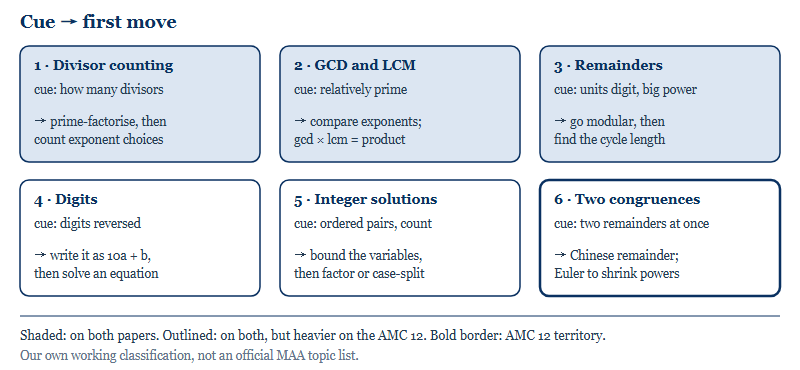
The table below is our own editorial classification, built from working through past papers with students rather than from any MAA taxonomy. Its value is the middle column: the phrase on the page that tells you which family you are in, before you have done any work.
| Family | Cue on the page | Forced first move | Paper |
|---|---|---|---|
| 1. Divisor counting | “how many positive divisors”, “perfect square divisor”, “sum of divisors” | Prime-factorise first, then count exponent choices | 10 & 12 |
| 2. GCD and LCM | “relatively prime”, “in lowest terms”, two cycles meeting again | Compare prime exponents; use gcd × lcm = product | 10 & 12 |
| 3. Remainders and cycles | “remainder when divided by”, “units digit”, a huge exponent | Work modulo the divisor; find the cycle length | 10 & 12 |
| 4. Digits and place value | “two-digit number”, “digits reversed”, “sum of the digits” | Rewrite as 10a + b and turn it into an equation | 10 & 12 |
| 5. Integer solutions | “positive integers such that”, “ordered pairs”, a constraint plus a count | Bound the variables, then factor or case-split | 10 & 12 |
| 6. Simultaneous congruences | Two or more remainder conditions at once; very large powers | Chinese remainder theorem; Euler to shrink the exponent | 12 |
The facts that have to be automatic, because there is no calculator
Every item below should be producible from memory in a second or two. If any of them requires thought, that is your first week of work — this is a short list and it does not get shorter later.
| Fact | Statement | Where it saves you |
|---|---|---|
| Divisor count | If n = paqb…, the number of positive divisors is (a+1)(b+1)… | Family 1, instantly |
| gcd and lcm | gcd(a,b) × lcm(a,b) = a × b | Family 2, and any “meet again” problem |
| Divisibility tests | 3 and 9 by digit sum; 11 by alternating digit sum; 4 by last two digits; 8 by last three | Families 3 and 4, and fast elimination of answer choices |
| Modular arithmetic | Congruences add, subtract and multiply; they do not divide freely | Family 3 — and the division rule is the classic silent error |
| Fermat / Euler | For gcd(a,n) = 1, aφ(n) ≡ 1 (mod n); for prime p this is ap−1 ≡ 1 (mod p) | Family 6, AMC 12 — collapses enormous exponents |
| Chinese remainder | Congruences with coprime moduli have a single solution modulo the product | Family 6, AMC 12 — turns two conditions into one |
The fourth row is the one that quietly destroys scores. Students internalise that congruences behave like equations, then cancel a common factor from both sides of a congruence without checking whether that factor shares anything with the modulus, and produce a clean, confident, wrong answer. There is no partial credit to soften it, and on a multiple-choice paper the wrong answer is frequently among the five options.
Three recognition drills
These are written for this article rather than taken from any paper, so you can use them freely. Cover the solution, name the family, then check whether your first move matched.
Drill 1. How many positive divisors of 24 × 32 × 5 are perfect squares?
Family 1. The cue is “divisors” plus a condition on those divisors. A divisor is a perfect square exactly when every exponent in it is even, so count the legal even exponents independently: 0, 2 or 4 for the prime 2 (three options), 0 or 2 for the prime 3 (two options), 0 only for the prime 5 (one option). That gives 3 × 2 × 1 = 6. Note what you did not do: you never listed a single divisor.
Drill 2. What is the units digit of 72026?
Family 3. The cue is “units digit” attached to an exponent far too large to compute — which always means a cycle. Powers of 7 end in 7, 9, 3, 1 and then repeat, a cycle of length 4. Since 2026 leaves remainder 2 on division by 4, the answer matches the second entry: 9. The whole problem is one division, once you have seen the family.
Drill 3. What is the smallest positive integer leaving remainder 2 when divided by 5 and remainder 3 when divided by 7?
Family 6 in miniature. Two remainder conditions at once is the Chinese remainder cue. List the numbers that are 3 more than a multiple of 7 — 3, 10, 17, 24 — and stop at the first one that is 2 more than a multiple of 5. That is 17, and every other solution differs from it by a multiple of 35. On the AMC 12 the same structure appears with moduli too large to list, which is where the theorem earns its place rather than the search.
Three drills, three different families, and in each case the recognition took a few seconds while the computation took under a minute. That ratio is the entire argument for studying number theory by family rather than by chapter.
How to build this block in the weeks before November
The 2026 papers are sat in person at authorised centres — the MAA publishes 5 November for the A papers and 13 November for the B papers, with your own sitting date coming from your test centre, and the conditions on the day are covered in our summary of the 2026 in-person arrangements. Working backwards from there, a realistic number theory build looks like this:
- Week 1 — close the fact list. Everything in the table above, from memory, no calculator. This is memorisation, and it is the only part of competition maths where memorisation is the right tool.
- Weeks 2 to 4 — drill recognition, not solutions. Take twenty number theory problems and, for each, write only the family and the first move. Do not solve them. Then check. You will find your errors are almost entirely misclassification, not arithmetic.
- Weeks 5 to 7 — solve to time. Now solve, with a stopwatch, aiming for under two minutes for anything in the first two-thirds of a paper. Number theory questions that take you six minutes are costing you two other questions.
- Weeks 8 onward — mixed sets only. The real difficulty on the day is that nothing is labelled. Practising twenty number theory problems in a row trains a skill you will never use in the exam hall, because there the family has to be identified cold.
- Throughout — log by cause. Distinguish “did not know the fact”, “named the wrong family”, “right method, arithmetic slip” and “misread the question”. Those four have four different fixes and lumping them under “number theory” fixes none of them.
For material, we maintain a compiled pack of past papers with answer keys and, for some years, worked video solutions; solution coverage varies by year, so build your plan around the answer keys and treat the videos as a bonus where they exist. Whatever you use, sit it under the real constraint — 25 questions, 75 minutes, no calculator, and the in-person conditions described in our 2026 rules summary. A number theory toolkit that only works with unlimited time is not yet a competition skill.
Frequently asked questions
Is number theory worth prioritising over geometry?
For most students, yes, early on. The toolkit is finite and memorisable, so hours convert into marks faster than they do in geometry.
Do I need the Chinese remainder theorem for the AMC 10?
No. It sits among the AMC 12 extensions as our teaching team reads the syllabus; confirm the current scope on maa.org. AMC 10 number theory stays with divisors, divisibility and congruence.
What is the most common number theory error?
Cancelling a factor inside a congruence without checking it is coprime to the modulus. It produces a clean answer that is wrong.
Can I use a calculator for the heavy arithmetic?
No. Calculators are not permitted on either paper, which is exactly why the divisibility tests and cycle tricks matter.
This is an independent English-language guide operated by Hanlin Education for China-based international-school students. We are not affiliated with, endorsed by, or sponsored by the Mathematical Association of America (MAA). Competition dates, eligibility rules, syllabus scope and scoring are set by the MAA and can change; the question-family classification used here is our own editorial working model, not an official MAA topic list. Always confirm current details on maa.org and with your authorised test centre. If you find an error in this article, tell us and we will correct it within 7 working days.